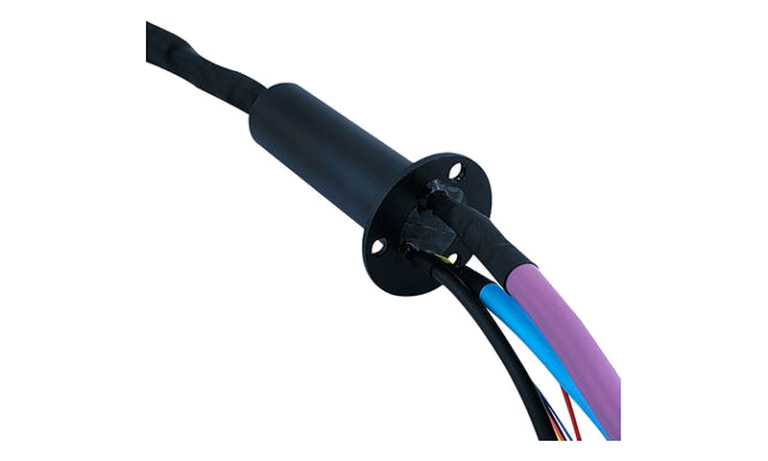
A wind turbine slip ring is one of the few components in the nacelle that runs for the entire service life of the machine, often twenty years, without a planned replacement. That changes the selection logic: it is not about finding the cheapest unit that fits, it is about specifying a unit whose wear rate you can predict.
What the turbine actually demands
A typical nacelle slip ring carries three groups of signals:
- Power for pitch motors and dehumidifiers, usually 400 VAC three-phase, with individual channels in the 10–20 A range
- Control and safety signals at low current, including emergency-stop loops that must not fail silently
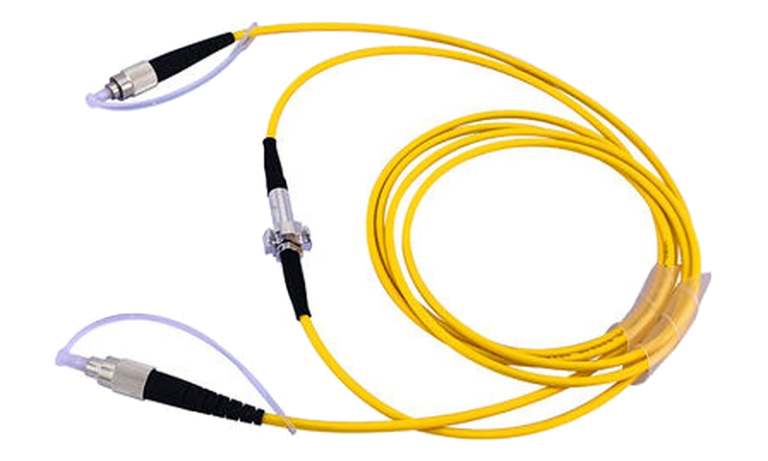
- Data — fieldbus, encoder or Ethernet, depending on the turbine generation
The unit also has to tolerate constant yaw movement, tower vibration and a nacelle environment that swings between saturated humidity and sub-zero temperatures.
Bore and circuit layout
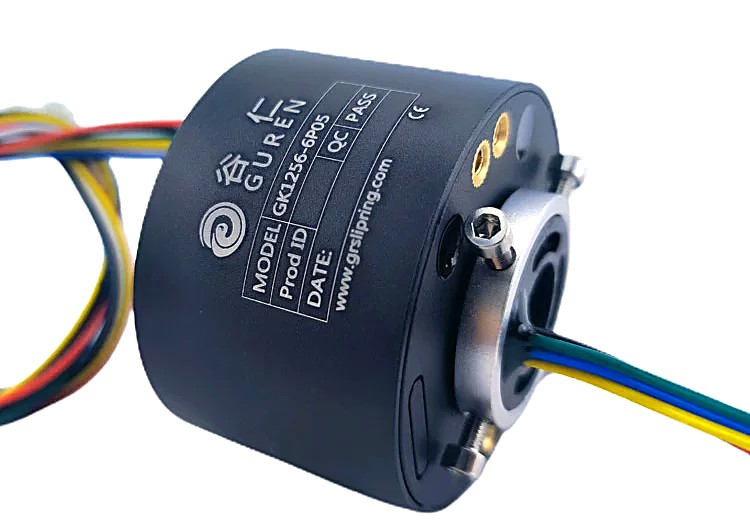
Wind turbine designs usually route cables through the hollow shaft, which makes a through-bore slip ring the natural choice. Bore sizes in the 25–50 mm range cover most designs; our GK2586 (25.4 mm bore, 86 mm OD), GK3899 (38.1 mm, 99 mm OD) and GK50119 (50 mm, 119 mm OD) are the models most often quoted for nacelle applications.
Standard circuit counts are 6, 12, 18, 24 and 36. In practice a turbine rarely needs all channels for power: the layout usually mixes power rings, low-current control rings and shielded data channels in one stack. When the data channel is Ethernet or a fieldbus, keep it physically separated from the power rings, and specify shielded leads.
Life expectancy is the specification that matters
Our through-bore family is offered in three life tiers: 20, 50 and 80 million revolutions. For a turbine that yaws a few hundred thousand revolutions per year, the middle tier is normally sufficient; the top tier exists for designs where the slip ring is inaccessible and replacement cost dominates the decision.
Ask for life in revolutions rather than years. Years depend entirely on how the machine is operated, and a quoted figure in years without the underlying revolution count is not a specification.
IP rating and temperature
Nacelle humidity is the main enemy. Electrical slip rings are available in IP51, IP65 and IP68 versions; for offshore or high-humidity sites, specify IP65 as a minimum. Note that there is no IP54 option in the catalogue — IP54 requests are normally answered with IP65, which exceeds the requirement.
The GK family is rated −30 to +80 °C and 0–85 %RH, which covers most onshore installations. Offshore units need the IP rating to do more of the work, because salt-laden air attacks the housing before temperature ever becomes an issue.
Maintenance: what to check and when
Slip rings are low-maintenance, not maintenance-free. A practical schedule for a nacelle unit:
- Every service visit — visual inspection through the inspection port: brush dust accumulation, discoloration on the rings, any sign of moisture
- Annually — measure insulation resistance and contact resistance; compare against the commissioning record rather than an absolute threshold
- Every five years — check brush length against the wear limit and clean the housing interior
Trending matters more than any single reading. A contact resistance that has doubled over three years is a warning even if it is still within limits.
Common failure modes and their causes
- Intermittent data errors — usually a shielding or grounding problem at the slip ring interface, not the ring itself
- Overheating — often undersized current rating or poor ventilation in a sealed housing
- Brush dust bridging — accelerated by humidity and by running near the current limit
- Moisture ingress — the single most common cause of premature replacement; check the IP rating against actual washdown and condensation conditions
Specifying a nacelle slip ring: the short version
Send the shaft diameter, the channel list with current per channel, the data protocol, the IP requirement and the expected annual revolutions. With those five items a model and a life estimate can be quoted directly, and any open point can be covered by a standard model with headroom rather than a custom design.
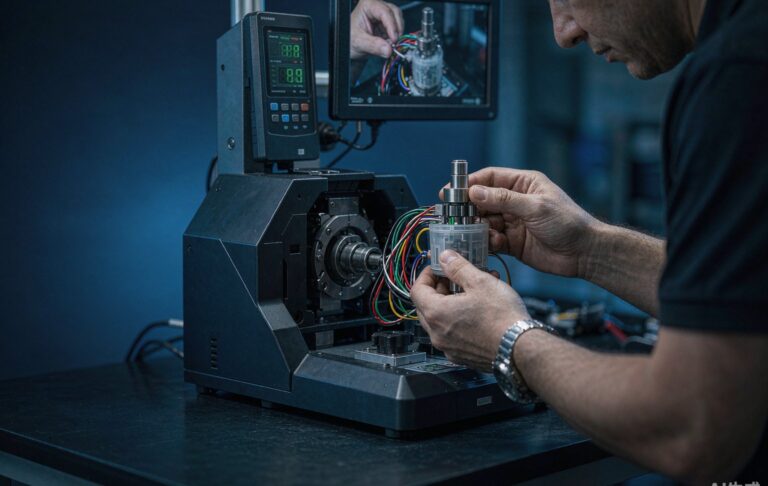
GUREN builds through-bore slip rings with in-house machining, assembly and dielectric testing. See GK through-bore models or send your nacelle requirements.