Slip rings come in three basic form factors, and the choice between them is almost entirely a question of where the space is. A machine that has a hollow shaft needs a different answer from a machine that has 20 mm of axial room and nothing else. This comparison covers what each form factor is good at, and where it stops making sense.
Through-bore: the workhorse
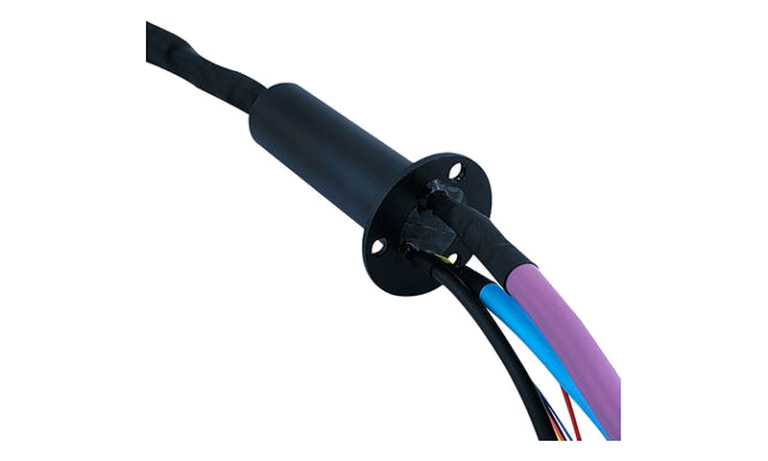
A through-bore slip ring has a hollow centre, so the shaft passes through it and cables can be routed down the bore. It is the default choice for industrial machinery because it mounts rigidly, handles vibration well, and scales from small to large bores.
- Bore range in our catalogue: 12.7 mm (GK1256, 56 mm OD) to 50 mm (GK50119, 119 mm OD)
- Circuit counts: standard grids of 6, 12, 18, 24 and 36
- Current: 5 A or 10 A per ring at 12.7 mm bore; 20 A per ring from 25.4 mm bore upward
- Life: three tiers at 20, 50 and 80 million revolutions
- Environment: IP51, IP65 and IP68 versions; −30 to +80 °C
Use it when the machine has a shaft to mount on, when you need a rigid mechanical interface, and when the circuit count is in the standard grid or close to it. It is also the easiest form factor to service, because the brushes are accessible without removing the rotor.
Capsule: small, light, and quick to specify
A capsule slip ring is a compact cylinder built from stacked discs, typically 12–25 mm in diameter. It is the right answer when the rotating joint is small — a sensor head, a small robot wrist, a camera turret — and the total circuit count is modest.
- Circuit counts: built to the count you need in small increments (4, 8, 12 circuits at the same diameter are common)
- Current: 5 A and 10 A per circuit are the usual options
- Life: 0.5 to 2 million revolutions, so plan for a consumable rather than a lifetime component
- Mounting: usually a set screw on the shaft and a torque arm on the housing
Use it when space is the constraint and the duty cycle is light to moderate. Do not use it where the machine runs continuously for years: the life figure tells you it is a maintenance item.
Pancake: axial space is the constraint
A pancake (disc) slip ring spreads the circuits radially instead of stacking them along the axis, so its axial height is small and its diameter is large. It fits when the machine has room around the shaft but not along it.
Pancake designs are commonly built for robotics, turntables and medical equipment where the rotating interface sits inside a flat housing. Because the circuits sit at different radii, the wiring layout is more complex than a through-bore stack, and the mechanical design is usually custom for each project.
If your machine has a large diameter envelope and a thin axial space, a pancake is worth discussing early — the design effort is higher, but the alternative is usually a redesign of the housing.
The comparison in one table
| Through-bore (GK) | Capsule (WX) | Pancake | |
|---|---|---|---|
| Space used | Radial, shaft passes through | Radial, small | Large diameter, thin |
| Typical circuit count | 6–36 (standard) | 4–12 | Custom |
| Current per ring | 5–20 A | 5–10 A | Custom |
| Life | 20–80 million rev. | 0.5–2 million rev. | Project-specific |
| Service access | Good | Replace as unit | Depends on design |
Other families worth knowing
Three further families cover cases the three main form factors do not:
- Mercury slip rings — liquid-metal contact, single channel, from 25 A up to 450 A at 400 V, 400–1,800 rpm. Useful for high current with very low and stable contact resistance.
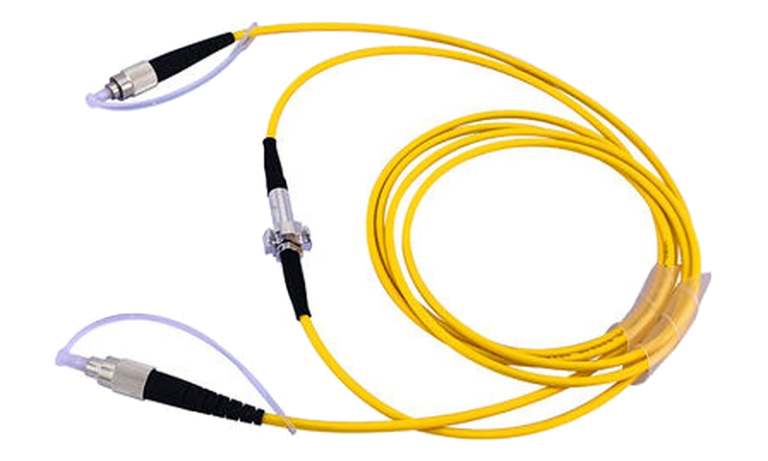
- Fiber optic rotary joints — optical channels for data-heavy applications, multi-channel models rated up to 100 million revolutions.
- Gas-electric rotary unions — fluid and electrical channels in one unit, for air, vacuum or coolant crossing the same rotating joint.
How to decide in practice
- Is there a hollow shaft? → through-bore
- No shaft, tiny space, moderate life? → capsule
- Large diameter available, thin axial space? → pancake (custom design)
- Very high current, single channel? → mercury
- Data-heavy, EMI-sensitive? → fiber optic or a screened stack
- Air or coolant also crossing the joint? → gas-electric
GUREN manufactures through-bore, capsule, mercury and fiber optic slip rings, plus gas-electric rotary unions. Send the shaft size and the channel list and we will confirm the form factor and the model. Browse product families or contact us.