Choosing a slip ring looks simple from the outside: pick a bore size and a number of wires. In practice most failed selections come from five parameters being considered separately instead of together. This guide walks through the five in the order that matters, with the ranges GUREN builds in volume.
1. Start with the bore, not the current
The bore (inner diameter) is driven by the shaft the slip ring has to sit on. If the machine already exists, the shaft diameter fixes the smallest sensible bore, and everything else has to fit around it. If you are designing the machine, the slip ring usually sits on the cheapest shaft you can live with, which is why 12.7 mm and 25.4 mm bores cover a large share of industrial applications.
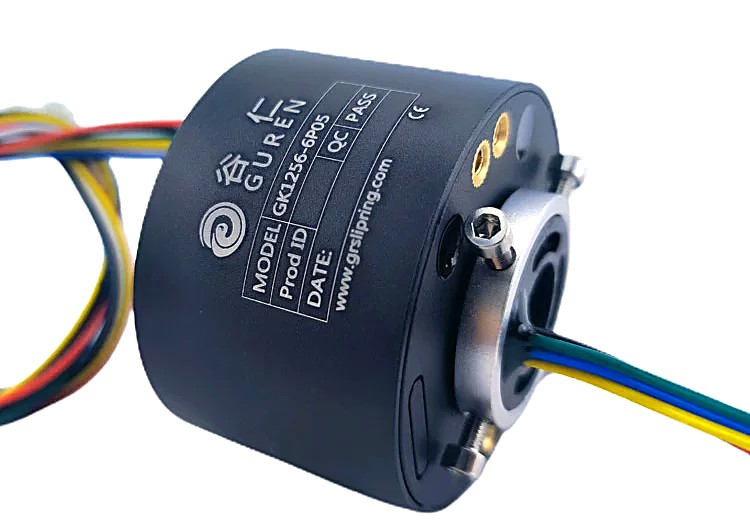
Our through-bore family runs from 12.7 mm (GK1256, 56 mm outer diameter) through 25.4 mm (GK2586, 86 mm OD), 38.1 mm (GK3899, 99 mm OD) up to 50 mm (GK50119, 119 mm OD). Each size has a fixed set of standard circuit counts, which is the second parameter.
2. Circuit count: the standard grid exists for a reason
Through-bore models are normally built with 6, 12, 18, 24 or 36 circuits. Those numbers are the standard internal layouts; anything else is a custom build with its own lead time and drawing. When a project needs, say, 8 circuits, the usual answer is a 12-circuit unit with four channels left unused — cheaper and faster than a custom 8-circuit stack.
Capsule (WX) models are different: they are built to the circuit count you need in small increments, because the stack is a simple series of discs. That is why a capsule can be 4, 8 or 12 circuits at the same outer diameter.
3. Current per ring — and why it changes the model
Current is where most selections go wrong. The same model family is offered at 5 A, 10 A or 20 A per ring, and the rating is tied to the bore: a 12.7 mm bore unit (GK1256) is built at 5 A or 10 A per ring, while 25.4 mm and larger models can carry 20 A per ring. If a design needs more than 15 A per channel on a small bore, the right move is parallel rings, not a bigger rating on the same model.
Capsule (WX) and cap-type models are available up to 30 A per ring. Beyond that, high-current designs (such as our mercury W-series, rated from 25 A up to 450 A per channel) become the practical route.
4. Voltage and signal type
Standard power channels are rated for 440 VAC, signal channels for 300 VAC, with a dielectric strength of 800 VAC for power rings and 300 VAC for signal rings. If the application mixes high-voltage power with low-level instrumentation on the same unit, plan the channel layout so power rings sit at one end of the stack — that is a mechanical decision, not a marketing one, and it is worth raising at the quotation stage.
5. Speed and life expectancy
Speed limits are usually well above what industrial machines actually run. Our through-bore family is designed for continuous operation well into the thousands of rpm, and the catalogue ceiling for the platform is 10,000 rpm. What buyers should look at instead is life expectancy in revolutions, because that is what determines maintenance intervals:
- GK through-bore, three tiers: 20, 50 and 80 million revolutions
- WX capsule: 0.5 to 2 million revolutions
- Cap-type: 2 million revolutions
- Q pneumatic / gas-electric: 20 million revolutions
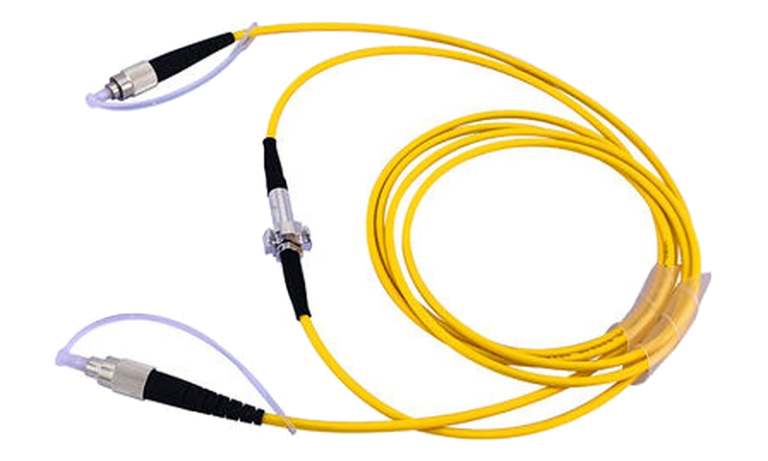
- GXMM multi-channel fiber optic: up to 100 million revolutions
If a machine turns at 300 rpm for eight hours a day, 20 million revolutions is roughly 140 operating days — useful context when comparing a cheap unit with a long-life one.
6. Environment: IP rating and temperature
Electrical slip rings are available in IP51, IP65 and IP68 versions. There is no IP54 catalogue option: when a drawing asks for IP54, the practical answer is to specify IP65, which exceeds it. For temperature, the GK family is rated −30 to +80 °C and 0–85 %RH.
If the machine sees coolant, chips or washdown, the IP rating matters more than any other single choice, because ingress is the most common cause of premature failure in the field.
A five-minute selection checklist
- Shaft diameter → minimum bore
- Available radial space → maximum outer diameter
- Number of power and signal channels → standard circuit grid or custom
- Current per channel → 5/10/20 A (up to 30 A cap-type), parallel rings above 15 A on small bores
- Environment → IP51 / IP65 / IP68, temperature range
Send those five numbers with a sketch of the mounting interface and a quotation can be issued the same week. If any of them is still open, our engineering team can propose a standard model that leaves room for the open item rather than waiting for the full specification.
GUREN manufactures slip rings and rotary unions in Shenzhen, with machining, assembly and dielectric testing in-house. For model-level data, see the slip ring product pages or send your requirements.